
Delaware Students Learn that any Job can be a Green Job
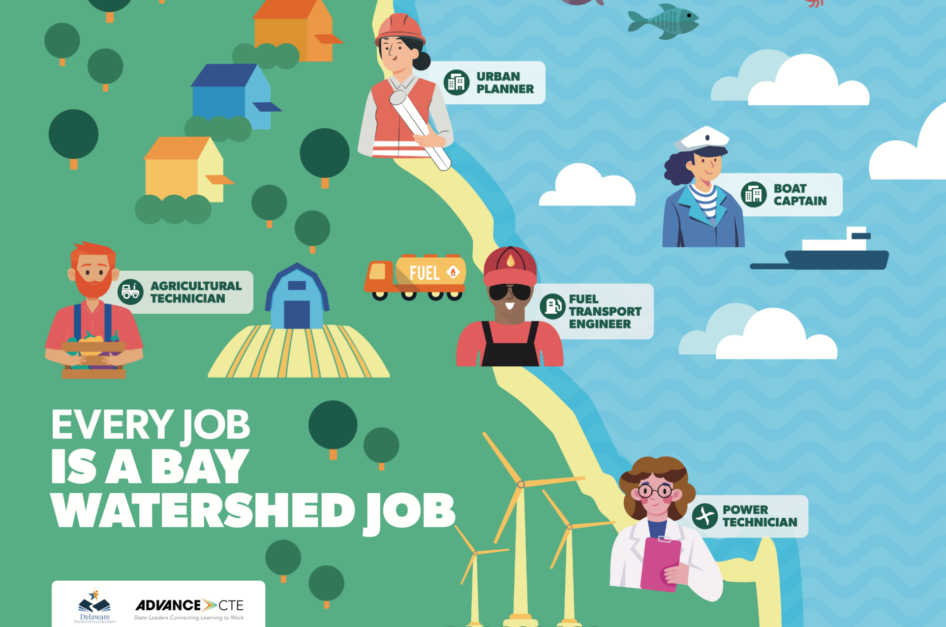
Download an image or printable PDF of the above poster from this resource page.
In Delaware, students are learning that any job can be a green job. In 2023, 78% of high school students in Delaware were enrolled in a Career and Technical Education (CTE) course. These learners, through the careers they pursue, the industries they grow, the challenges they address, and the decisions they make, will shape both Delaware’s economy and the state’s environment.
“Delaware is at the forefront of integrating environmental literacy into middle grades and secondary Career Technical Education (CTE), recognizing CTE’s critical role in workforce development and environmental sustainability. As the state faces growing environmental challenges—increasing temperatures, sea level rise, deforestation, heavier precipitation, and flooding—and related economic and labor market conditions change, the urgency to cultivate a climate-resilient workforce has never been greater. [...] Recognizing the urgency of equipping learners with the tools to implement sustainable practices across all career pathways, the state has positioned environmental literacy as a critical component of CTE.” - Integrating Environmental Literacy Into Career Pathways: A Delaware Case Study
What is Career and Technical Education?
Career and Technical Education (CTE) programs prepare students for high-wage, high-demand industries by combining academics, technical instruction for specific careers, and work-based learning experiences. Students in CTE programs often take additional specialized courses that emphasize real-world skills and practical knowledge within a selected career focus. Students in CTE programs also often have the opportunity to take part in internships, engage with mentors, and deepen their learning through hands-on projects. Students can participate in CTE at the middle or high school level and at postsecondary institutions. Learn more with Advance CTE and MDRC resources.
The Delaware Approach
All jobs, which help Delaware respond to environmental challenges and implement sustainable practices, can be green jobs. That is why the Delaware Department of Education, with funding support from NOAA’s Chesapeake Bay Watershed Education and Training program, partnered with Advance CTE, educators, leaders in workforce development, state agencies, and students enrolled in CTE programming to develop a framework to embed environmental literacy into CTE pathways through the Delaware Pathways initiative. This initiative directly connects environmental literacy to workforce development, ensuring that learners not only understand environmental issues but also develop the technical skills to address them.
“[Focusing on environmental concepts] really just brings it to the forefront of your mind. There’s so many things I didn’t think about before. I want to make sure my future students can learn about this stuff too.”
- 9th grader, Teacher Academy
One of the first steps in this effort was to work closely with partners, educators and students to develop and revise the Environmental Literacy Competencies. What made this project unique was that the learners, alongside teachers, partners and industry representatives, were very involved in this process. Learners completed surveys, participated in listening sessions and nine of them joined in the Environmental Literacy Student Champions (ELSC) group which provided feedback on resources, collaborated on the development and implementation of professional learning opportunities, and provided guidance on opportunities to cultivate learner interest and center learner voice.
The competencies were intentionally crafted to be cross-cutting and interdisciplinary, directly connecting to Delaware’s science and social studies curriculum and applicable across all CTE Pathways. They are specific enough to meet environmental and economic needs and broad enough to help learners in all career pathways develop a clear connection between their career of choice and interest and the environmental outcomes connected to that field.
To support the seamless integration of environmental literacy within CTE curricula, the project team created the Environmental Literacy in CTE Framework which includes: lists of green careers for each career sector, alignment of knowledge and skills to academic standards and Delaware’s environmental literacy plan; and resources to support CTE educators in curriculum integration. The Framework is additionally broken out by ten career clusters such as AgriScience, Health Science, and Information Technology.
“When I’m able to make connections to the environment, I can see additional impact for my career. I didn’t think about it as much before, but I definitely do now.”
- 12th grader, Animal Science
Workforce Development and CTE Gain Regional Momentum
In December, Governors from states throughout the Chesapeake Bay watershed, and the Mayor of the District of Columbia, approved and recommitted to the revised Chesapeake Bay Agreement. The Agreement has a new Workforce Outcome, which invites watershed states to increase the ability of all job seekers in the watershed to understand, participate in and succeed in career pathways that positively support the Chesapeake Bay watershed. Environmental, education, and workforce professionals will be engaged across the watershed to inform and grow implementation of strategies that help students, educators and job seekers become aware of and understand environmental careers and the in-demand skills and pathways to access these opportunities by 2040.
Additionally watershed states, like Delaware, are updating their career programming standards and resources to better align with current workforce needs and industry projections.
Maryland – The Blueprint for Maryland’s Future elevates the significance of career and technical education and encourages the development of programming that supports students in participating in apprenticeship opportunities and earning industry recognized credentials. Maryland also updated the CTE Programs of Study including a new one focused on Renewable Energy.
Pennsylvania –The state recently released the updated Career Education and Work Standards and has invested substantially in apprenticeship and pre-apprenticeship programming.
District of Columbia – The Green Zone Environmental Program (GZEP) offers young adults, ages 14 to 24, with an opportunity to learn about energy and environmental issues, complete community-based environmental work projects and prepare for careers. DC also has some CTE programs that center sustainability at Anacostia High School, Ron Brown College Preparatory High School and Calvin Coolidge High School.
Virginia – The Governor's STEM Academies are programs designed to expand options for the general student population to acquire STEM (Science, Technology, Engineering and Mathematics) literacy and other critical skills, knowledge and credentials that will prepare them for high-demand, high-wage, and high-skill careers in Virginia.
Explore Resources and Join the Conversation
With the increased regional focus on career related programming, now is a great time to connect with new and current partners at schools, school districts and state departments of education to learn about their career programming. Ask partners how you might connect by offering internships/apprenticeships, industry recognized credentials, or incorporating more job skills and awareness within your programming.
On the heels of the Advance CTE and Delaware collaboration, Advance CTE produced a series of resources that support efforts to uplift green careers in future CTE work.
Green in CTE Resource Repository - This is a growing collection of related state and federal policies and programs, curricular/advisory resources, research and environmental literacy resources.
Seeing Green: CTE as a Catalyst for the Green Workforce - This is a policy playbook that equips education and workforce leaders with actionable strategies to strengthen pathways into emerging green careers by leveraging the effective structures, mindsets, and collaboration provided through Career Technical Education (CTE).
Green Workforce in the National Career Clusters Framework - This brief is intended to support the adoption and implementation of the National Career Clusters® Framework, the central building block to achieve consistently designed and high-quality Career Technical Education (CTE) programs.
Embedding Environmental Literacy Into Career and Technical Education in Delaware: Findings and implications from an Early-Phase Implementation Study - This is an article by researchers at MDRC.